
Tui Digital Article
Website Traffic Dropped in Late August? The Google August 2026 Spam Update May Explain It
Traffic vanished in late August? The Google August 2026 spam update ran from 19 to 21 August NZ time. Here is how to check what happened.
Current as of 4 September 2026.
Your Search Console graph drops hard. Impressions disappear. Rankings move. The phone goes quiet.
If your traffic fell between 19 and 21 August 2026 in New Zealand, the Google August 2026 spam update is one possible reason. It is not the only possible reason, so it is worth checking properly before you start deleting pages or rewriting the whole site.
This post explains what Google released, how to tell whether the update affected you, and what to do next. It also covers the part most people skip: whether the traffic you lost was ever useful.
What Google Released
Google started the August 2026 spam update on 18 August US Pacific time and marked it complete on 21 August US Pacific time.
In New Zealand, that lines up roughly with 19 to 21 August 2026.
Google described it as a spam update that applied globally and across all languages. It did not announce a new rule. It was an update to how Google applies its existing spam systems.
That matters, because a lot of the advice online makes it sound like Google suddenly changed everything. It did not say that. Google simply confirmed the rollout.
Third-party tracking also showed heavy movement. Search Engine Land reported SE Ranking data showing that 16.71% of URLs that had been in the top 10 dropped beyond position 100 during the update, compared with 9.2% in a similar July period.
So yes, the update was real. And for some sites, the drop was sharp.
References:
What The Drop Can Look Like
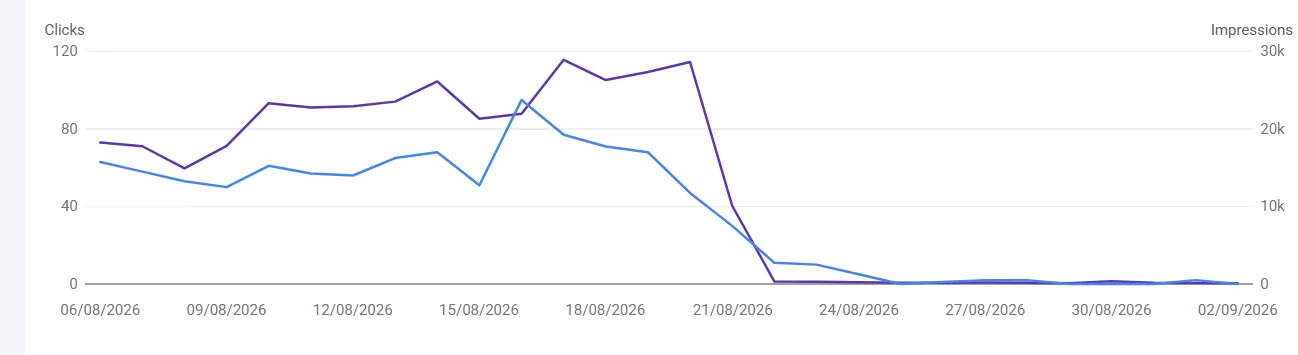
We reviewed Search Console data for one New Zealand site caught in the timing of this update.
For three months, the site was sitting around 25,000 to 28,000 impressions a day.
Then the graph changed quickly:
- 20 August: 10,095 impressions
- 21 August: 333 impressions
- After that: mostly 150 to 350 impressions a day
Average position also moved from around 8 to somewhere between 20 and 48.
That is not a small ranking change. A normal ranking drop might look like position 4 slipping to position 9. This looked more like the site being removed from a large number of searches it used to appear for.
If your graph looks like a cliff, you may be dealing with a site-wide quality or spam signal.
If your graph looks like a slow decline, the update may not be the main cause.
What Spam Updates Usually Go After
Google’s spam policies cover things like:
- Pages created at scale with little real value
- Doorway pages made only to catch keyword variations
- Scraped or copied content
- Thin affiliate-style content
- Content published mainly to manipulate rankings
- Site reputation abuse, where unrelated content is placed on a stronger domain to borrow its authority
AI is not automatically the problem.
The problem is publishing pages with no real judgement, no original value, and no clear reason to exist.
A local business site can get into trouble when it starts publishing random articles just to chase traffic. For example, a trade business posting generic lifestyle content, finance explainers, recipe-style posts, or broad national articles that have nothing to do with what the business actually sells.
That kind of content might bring impressions for a while, but it can also make the whole site look messy.
How To Check If The August 2026 Spam Update Hit You
Do this before you make changes.
1. Check Manual Actions First
Open Google Search Console and go to the Manual Actions report.
If there is a manual action, a human reviewer has flagged the site. That is different from an algorithm update. You will need to clean up the issue and submit a reconsideration request.
If there is no manual action, the drop may still be algorithmic.
2. Check The Exact Dates
Open Search Console performance data and look closely at 19 to 22 August 2026.
If the drop happens inside that window, the spam update is a possible cause.
If the drop starts earlier or later, check other causes first.
Look for:
- Website changes
- URL changes
- Redirect mistakes
- Noindex tags
- Robots.txt changes
- Tracking problems
- Seasonal search drops
- A big competitor change
Do not blame the update just because it is nearby.
3. Check Whether The Whole Site Dropped
Go to the Pages report in Search Console.
Sort by impressions.
If most of your top pages dropped at the same time, that points to a wider site issue.
If only one section dropped, look at what is different about that section. It may be thin, off-topic, duplicated, or built too heavily around search phrases.
4. Separate Clicks From Impressions
This is important.
A drop in impressions means Google stopped showing your pages as often.
A drop in clicks while impressions stay steady can mean something else changed in the search results. For example, Google may be answering the question directly, showing more ads, or showing a different type of result.
Do not treat both problems the same way.
5. Check Whether Important Pages Are Still Indexed
Use URL Inspection in Search Console on your main money pages.
Check:
- Is crawling allowed?
- Is indexing allowed?
- Is the page indexed?
- Is Google choosing the same canonical URL as you?
- Is the page returning 200, not redirecting?
If important pages are not indexed, fix that before worrying about content quality.
The Number Most People Ignore
Here is the part that changes the decision.
The site we reviewed had 1,174,653 impressions over three months and 3,757 clicks.
That is a click-through rate of 0.32%.
For a site with an average position around 8, that is very low.
One page was producing 57% of all impressions but only converting at 0.26%. It ranked for a question Google could answer directly in the search results, so most people had no reason to click.
Another page pulled 78,931 impressions from one brand-related search and got 26 clicks. That makes sense. People searching for that brand were probably trying to reach the brand, not read a page about it.
But the local service pages were different. They had fewer impressions, but click-through rates around 4% to 7%.
That is the real lesson.
Not all traffic is worth saving.
A million impressions from people who never click is not as useful as a few hundred visitors who are actually looking for a service.
Before you spend money trying to recover traffic, check what the lost traffic was doing. Sort your Search Console pages by clicks, not just impressions. Then look at which pages brought real visitors.
What To Do Now
1. Do Not Panic Delete Pages
Deleting useful pages can make the problem worse.
Start by finding the pages that were only getting impressions and not clicks. Then ask whether those pages help a real person or only exist to catch a search term.
If the answer is only “traffic”, that page probably needs to be improved, merged, redirected, or removed.
2. Protect Your Money Pages
Your service pages matter most.
For a local business, that usually means pages for:
- Your main services
- Your main location
- Your contact page
- Your proof or case studies
- Your highest-intent blog posts
Make sure those pages are indexed, internally linked, and clearly written for customers.
If you are a Christchurch business, your local service pages should explain what you do, where you do it, who it is for, and how someone can contact you.
3. Clean Up Off-Topic Content
Look for articles that do not match your business.
A few examples:
- A local trade business writing generic national news
- A service business publishing unrelated finance content
- A website agency posting random “best tools” content with no real testing
- Pages made by swapping suburb names without adding local detail
That kind of content may have worked for impressions in the past. It is less safe now.
4. Improve Pages That Deserve To Stay
Some pages are worth keeping but need work.
Improve them by adding:
- Real examples
- Local detail
- Clearer answers
- Better headings
- Internal links to relevant service pages
- Screenshots or data where useful
- A clear next step
Do not just make them longer. Make them more useful.
5. Be Careful With Multiple Websites
If your commercial service content is spread across unrelated domains, review that setup carefully.
Sometimes one strong website is better than several thin ones. We have written more about that here: one website versus several websites for multi-location SEO.
6. Expect Recovery To Take Time
Google says recovery from spam updates can take many months after the issue is fixed.
That means you should not expect a quick bounce-back next week.
Fix the real problem, then keep your leads moving through other channels while Google reassesses the site.
That might mean Google Ads, email, referrals, social content, or direct outreach while SEO settles.
Common Questions
Is This The Same As A Google Penalty?
No.
A penalty is usually called a manual action. It appears inside Google Search Console.
The August 2026 spam update is algorithmic. You will not get a message from Google saying it hit you.
The fixes can overlap, but they are not the same thing.
My Traffic Dropped In September. Was It Still This Update?
Maybe, but do not assume that.
Search Console data can lag by a couple of days, but a drop that starts well after the rollout needs a wider check.
Look at site changes, tracking, indexing, redirects, competitors, and seasonal demand.
Will Deleting Old Blog Posts Fix It?
Only if those posts were genuinely low value.
Deleting useful content is a bad move. Removing or merging pages that were only written to catch search traffic can make sense.
The test is simple: would a real customer be glad this page exists?
Does AI-Written Content Cause This?
Not by itself.
The issue is low-value content at scale. That can be written by AI or by people.
If a page has no original thought, no real experience, no clear audience, and no reason to exist beyond rankings, it is a risk.
We have also written about where AI can genuinely help New Zealand businesses.
How Long Until Traffic Comes Back?
Plan for months, not weeks.
If the drop was caused by a spam update, recovery usually depends on fixing the underlying issue and waiting for Google to reassess the site.
In the meantime, focus on the pages and channels that can still bring enquiries.
Need A Second Opinion?
If your traffic dropped in August and you are not sure whether it was the spam update, a technical issue, or traffic that was never valuable in the first place, we can help you read the data.
Start with our SEO services, or book a consultation and we will give you a straight answer on what is worth fixing.